By 2026, AI agents will shift agencies from labor-intensive delivery to supervised automation, handling research, drafting, project coordination, and reporting end-to-end. Account teams will manage fleets of agents instead of executing every task manually, compressing turnaround times and reshaping how agencies price, staff, and scope client work. Margins improve when output stops scaling linearly with headcount.
What AI Agents Actually Change in Agency Workflows
The difference between today's AI tools and 2026 AI agents is autonomy. A chatbot answers a prompt. An agent takes a goal, breaks it into steps, calls tools, checks its own work, and reports back. Most agencies get this distinction wrong and bolt a chatbot onto an old process expecting transformation.
The practical impact lands across four areas:
- New business and proposals — agents draft RFP responses, pull from past-win libraries, and tailor pitches per prospect
- Project delivery — agents generate first-draft creative, code, copy, and analysis for human review
- Operations — agents handle scheduling, status updates, time tracking, and resource allocation
- Client communication — agents draft updates, summarize calls, and surface risks before they escalate

Proposals and Pitch Work Get Faster
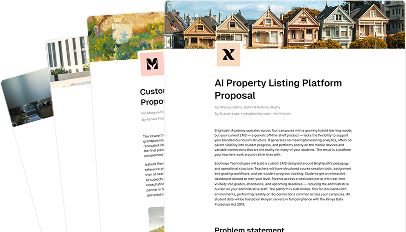
Proposal writing is where agencies bleed the most unbillable hours. AI agents in 2026 will assemble responses from a structured content library, match scope to deliverables, and draft pricing scenarios in minutes instead of days. The bottleneck moves from writing to reviewing.
Teams that already maintain clean answer libraries win here. If you've ever managed an RFP answer migration between platforms, you know structured, reusable content is the foundation agents need to perform well. Garbage libraries produce garbage drafts.
The same logic applies to discovery. Agents will prep brief documents, surface relevant case studies, and flag scope risks before a sales discovery call, letting account leads walk in with context they used to spend hours assembling.
Client Delivery Shifts to Supervised Output
The biggest operational change is the review-first model. Instead of a junior creating a deliverable from scratch, an agent produces a 70-80% draft and a human refines it. This flips the labor math:
- Junior work shrinks — agents absorb research, formatting, and first drafts
- Senior judgment grows — reviewers spend time on strategy, quality, and client fit
- Cycle times compress — drafts arrive in hours, not days
- Capacity decouples from headcount — one strategist can oversee far more output
This doesn't mean fewer people overnight. It means different people doing different work. Agencies that treat agents as accelerators for skilled staff outperform those chasing pure cost-cutting.
Quality Control Becomes the New Constraint
When output volume jumps, review capacity becomes the limiting factor. Agencies will build QA layers where a second agent checks the first agent's work against brand guidelines, factual accuracy, and client requirements before anything reaches a human. Anthropic's research on agentic systems and similar work from major labs point to this multi-agent checking pattern as a reliability requirement, not a nice-to-have.
Pricing and Business Models Will Adapt
Hourly billing breaks when a task that took eight hours now takes 30 minutes of supervision. Expect agencies to move toward:
- Value-based pricing tied to outcomes, not time
- Retainer redesigns that bundle agent-driven monitoring and reporting
- Productized services where repeatable deliverables get fixed prices
This mirrors the build-versus-outsource debate teams already face with go-to-market functions. The same tradeoffs that shape SDR outsourcing versus an in-house team — control, cost, quality consistency — now apply to whether you run AI delivery in-house or lean on platforms.

What Agencies Should Do Now to Prepare
The agencies that thrive in 2026 start preparing in 2024-2025. Practical moves:
- Clean your data — structured content libraries, tagged case studies, and templated processes feed agents the context they need
- Pick supervised pilots — automate one workflow end-to-end, like weekly client reports, before scaling
- Redefine roles — train staff to direct and review agents, not just execute tasks
- Build QA gates — never ship agent output without a verification step
- Measure honestly — track cycle time, revision rounds, and margin, not just speed
Start small. A single agent handling status updates and meeting summaries proves the model and builds trust faster than a sweeping overhaul.
Risks and Limits to Watch
Agents hallucinate, misread brand voice, and confidently produce wrong work. As of recent model versions, none of this is fully solved. Client trust evaporates fast when a confident-sounding deliverable contains fabricated data. The agencies that win treat agents as fast junior staff who need supervision, not autonomous experts.
Data security matters too. Feeding client data into third-party agents raises confidentiality questions that legal and procurement teams will scrutinize, especially in regulated industries.
Key Takeaways
- By 2026, AI agents will handle research, drafting, coordination, and reporting under human supervision
- Proposal and delivery cycle times compress dramatically when content libraries are clean and structured
- Quality control and review capacity become the new bottlenecks, driving multi-agent checking
- Pricing shifts from hourly to value-based and productized models
- Prepare now by structuring data, running supervised pilots, and retraining staff to manage agent output
Agencies that decouple output from headcount while keeping a tight quality leash will set the margin benchmark the rest of the industry chases.