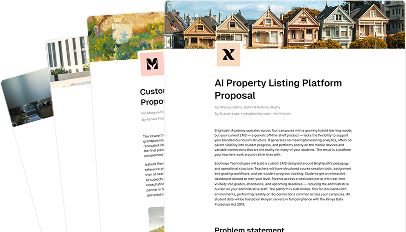
A B2B sales proposal that closes six-figure deals faster leads with the buyer's outcome, not your product. Structure it as: executive summary, problem statement, proposed solution, measurable ROI, pricing options, implementation timeline, proof, and a clear next step. Keep it under 12 pages, written for the economic buyer who signs the check.
Most teams get proposal structure backwards. They open with company history and a feature dump, then bury the business case on page nine. By then the executive sponsor has skimmed and forwarded it to procurement. The order below fixes that.
The 8-section structure that closes six-figure deals
Large deals stall when a proposal forces a decision-maker to assemble the value story themselves. Each section should answer one question the buying committee is already asking.
1. Executive summary (1 page)
This is the only page some VPs will read. Lead with the outcome and the number: "Reduce contract cycle time by 40% and recover $1.2M in stalled revenue within two quarters." Name the business problem, the proposed approach, the expected return, and the investment. Write it last, after the rest is done.
2. Problem statement (1 page)
Mirror the language from your discovery process. If you ran a strong sales discovery call, you already have the buyer's exact words about cost, risk, and urgency. Quote them. This proves you listened and anchors the deal to a problem worth six figures.
3. Proposed solution (2-3 pages)
Describe what you'll deliver in terms of their workflow, not your feature list. Map each capability to a problem from section 2. Use a simple two-column table:
| Their challenge | How the solution addresses it |
|---|---|
| Manual proposal assembly takes 6 hours | Automated templates cut it to 30 minutes |
| No version control across reps | Centralized content library with approvals |
| Slow legal review | Pre-approved clause blocks |

4. ROI and business case (1-2 pages)
Six-figure buyers need a defensible number to justify the spend internally. Show the math, not a vague "increase efficiency" claim.
Current state:  200 proposals/yr × 6 hrs × $75/hr = $90,000 labor
Future state:   200 proposals/yr × 0.5 hr × $75/hr = $7,500 labor
Annual savings: $82,500
Deal size:      $120,000
Payback:        ~17 months, then net positive
Frame it the way a qualification framework like MEDDIC would. Understanding how MEDDIC compares to BANT and SPIN helps you surface the metrics and economic buyer that make the ROI section land.
5. Pricing with options (1 page)
Never present a single price. Offer three tiers (good/better/best) so the buyer chooses how much rather than whether. Anchor with the highest tier first. Make the middle option the obvious fit. Include what each tier covers, and avoid hidden line items that trigger procurement scrutiny.
6. Implementation timeline (1 page)
Reduce perceived risk by showing a concrete rollout. A Gantt-style chart with named phases, owners, and milestones tells the buyer the project is already de-risked.
Week 1-2   Kickoff + data import        (You + Customer)
Week 3-4   Template configuration       (Your CS team)
Week 5     Team training                (Joint)
Week 6     Go-live                      (Customer-led)
7. Proof and social validation (1 page)
Include one tightly relevant case study, two short quotes, and any hard metrics. Match the proof to the buyer's industry and deal size. A logo wall is weaker than a single peer-company result with a number attached.
8. Clear next step (half page)
End with one specific action and a date: "Sign by [date] to start onboarding before Q3." Add a signature block or e-sign link. Ambiguous closes ("let us know your thoughts") kill momentum.
Tactics that speed up the close
Structure gets you in the door. These habits compress the cycle.
- Send a proposal only after multi-threading. Deals with 3+ stakeholders engaged close faster. Map the buying committee before you write.
- Pre-sell the proposal live. Walk the executive sponsor through it on a call rather than emailing a PDF cold. You control the narrative and catch objections in real time.
- Use a deadline tied to their reality, like a budget cycle or quarter-end, not an artificial discount clock.
- Keep it short. A focused 10-page proposal outperforms a 40-page document. Cut anything that doesn't move the decision.
- Personalize from CRM data. Pull discovery notes, stakeholder roles, and prior touches straight from your pipeline tool. Teams running HubSpot Sales Hub or Salesforce Sales Cloud can auto-populate proposal fields and cut prep time.
Research from Gong on winning sales conversations consistently shows that deals advance faster when reps quantify value and confirm next steps explicitly, both of which live in your proposal structure.

Common mistakes that stall six-figure deals
- Feature dumping instead of outcome framing.
- Single-price pricing that forces a yes/no instead of a choice.
- No ROI math, leaving the economic buyer to build the case alone.
- Burying the next step so the deal drifts after delivery.
- Generic templates that ignore discovery language and signal low effort.
Key takeaways
- Lead with the buyer's outcome and a number, not your company background.
- Use the 8-section order: summary, problem, solution, ROI, pricing options, timeline, proof, next step.
- Show defensible ROI math and offer three pricing tiers to drive faster decisions.
- Pre-sell the proposal live and tie the close to the buyer's real deadline.
- Keep it tight: 10-12 pages, every section earning its place in the decision.