Micro agencies outperform full-service shops in the AI era because AI tools collapse the labor advantage that big agencies once held. A 3-5 person team now ships what used to take 20 people, with lower overhead, faster turnaround, and tighter specialization. Clients get senior talent on every account instead of junior staff billing partner rates.
The old moat was headcount. That moat is gone.
What changed: AI erased the headcount advantage
For decades, full-service agencies won on scale. They had the bodies to staff a campaign, build the deck, write the copy, run the media buy, and produce the assets. A client couldn't replicate that internally, so they paid for the machine.
Generative AI broke that logic. A single strategist with Claude, GPT-4o, and a stack of automation tools can now produce first drafts, research, creative variations, and analysis at a pace that used to require a department. The bottleneck moved from production capacity to judgment and taste, which don't scale with headcount.
Most full-service shops got this wrong. They treated AI as a cost-cutting layer on top of the same bloated structure instead of rethinking the structure itself.

The cost structure problem at full-service shops
Big agencies carry expensive baggage:
- Layered management — account directors, supervisors, and coordinators who add margin but not output
- Office leases and overhead spread across underutilized teams
- Junior staff billed at senior rates to cover the pyramid
- Slow internal handoffs between siloed departments
A micro agency runs flat. The person you talk to is the person doing the work. No telephone game, no markup on a junior copywriter's first attempt. When AI handles the grunt work, the remaining humans are genuinely senior, and that shows up in quality.
Margins flip in favor of small teams
When production costs drop, the agencies with the lowest fixed overhead capture the most margin. A micro shop billing $30K a month with two operators and an AI stack keeps far more than a full-service agency billing $150K with 15 people on the account.
Speed is the new differentiator
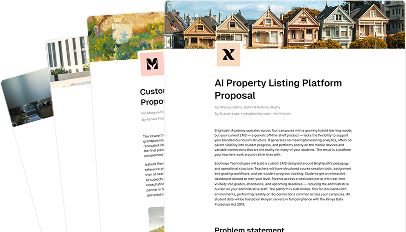
Clients increasingly buy speed. A micro agency can turn a sales discovery call into a proposal, creative concepts, and a launch plan in days instead of weeks. There's no internal approval chain, no resource-allocation meeting, no waiting for a creative team to free up.
This matters most in fast-moving channels. According to HubSpot's research on agency trends, clients now expect rapid iteration and measurable results over polished long-form pitches. Micro agencies are built for that cadence.
Specialization beats generalist breadth
Full-service means "we do everything," which often means "we're average at most things." Micro agencies win by going narrow:
- Vertical focus — only SaaS, only DTC skincare, only fintech
- Channel focus — paid search experts, lifecycle email specialists, LinkedIn ABM
- Outcome focus — pipeline generation, proposal win rates, demand capture
That depth lets a tiny team out-execute generalists. A specialist who's run 200 account-based marketing programs for enterprise SaaS will beat a full-service shop dabbling across ten industries every time.
How micro agencies use AI operationally
The winning micro agencies don't just use ChatGPT for copy. They build systems:
- Research and discovery automated across prospect accounts before kickoff
- Proposal and RFP generation using AI knowledge bases that recycle winning answers
- Creative variation spun up in batches, then human-curated
- Reporting auto-assembled from connected data sources
The human stays in the loop for strategy and quality control. AI handles volume. This is the same shift happening in enterprise sales, where teams debate SDR outsourcing versus in-house BDR builds — leverage and economics decide the winner, not headcount.

Where full-service shops still win
This isn't universal. Large agencies hold an edge when:
- The engagement spans massive global media budgets requiring procurement scale
- Enterprise clients need a single throat to choke across 15 markets
- Regulatory, legal, and compliance layers demand institutional process
- The brand wants the reputational safety of a name-brand holding company
Big multinational accounts with nine-figure budgets aren't going to a four-person shop. But the mid-market — the bulk of agency revenue — is moving toward lean, AI-native teams.
What this means for agency operators
If you run or are starting an agency, the strategic implications are clear:
- Stay small on purpose. Headcount is now a liability, not an asset.
- Pick a lane. Specialization is your moat now that production is commoditized.
- Build an AI operating system, not a bigger team.
- Sell outcomes and speed, because that's what AI lets you deliver cheaper than incumbents.
The agencies struggling most are mid-sized — too big to be lean, too small to compete with holding companies on scale. They're getting squeezed from both ends.
Key Takeaways
- AI eliminated the headcount advantage that made full-service agencies dominant.
- Micro agencies win on lower overhead, faster delivery, and senior talent on every account.
- Specialization beats generalist breadth now that production is commoditized.
- Full-service shops still hold ground on massive global accounts and complex enterprise compliance.
- The mid-sized agency is the most exposed — caught between lean operators and holding-company scale.