Fix inconsistent voice across multiple SME contributions by enforcing a shared style guide, assigning a single "one-voice" editor for a final harmonization pass, and using templated answer structures so subject matter experts (SMEs) drop content into a consistent framework. Tone, tense, terminology, and reading level should all be standardized before submission.
Why SME contributions sound inconsistent
When five engineers, a security lead, and a finance analyst each write a section, you get five writing styles stitched into one document. Each person brings their own tense, jargon density, and sentence rhythm. Evaluators notice. A proposal that reads like a relay race signals weak coordination, and that perception bleeds into scoring.
The usual culprits:
- Mixed tense and person — one SME writes "we will deploy," another writes "the team deploys," a third uses passive "deployment is performed."
- Jargon mismatch — technical SMEs over-explain to peers; sales SMEs over-simplify.
- Terminology drift — "platform," "solution," and "system" used interchangeably for the same thing.
- Reading-level swings — a dense 30-word sentence next to a choppy fragment.
- Formatting chaos — bullet styles, capitalization, and number formats that don't match.
Most teams get this wrong by treating editing as proofreading. Catching typos isn't the same as unifying voice.
Build a style guide before SMEs write
The cheapest fix happens before anyone drafts. A one-page proposal style guide sets the rules:
| Element | Standard to enforce |
|---|---|
| Voice | Active, present or future tense |
| Person | First-person plural ("we") for your firm |
| Product naming | One canonical term per concept |
| Reading level | Grade 9–11 (check with a readability tool) |
| Numbers | Spell out one through nine, numerals for 10+ |
| Acronyms | Define on first use, then abbreviate |
Share it as a pinned doc and a comment in the template. The Plain Language guidelines are a solid free reference for setting active-voice and reading-level rules.
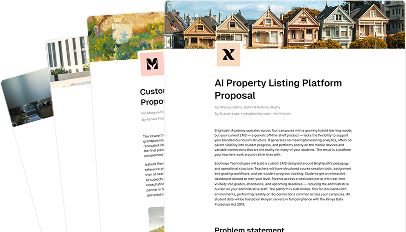
Use templated answer structures
Give SMEs a skeleton, not a blank page. A repeatable structure—claim, evidence, proof point, benefit—forces consistency even when the prose varies. This also helps with vague past performance examples by prompting SMEs for specific metrics instead of generic capability statements.
Example prompt block for each section:
Claim: What we do (one sentence, active voice)
Approach: How we do it (2-3 sentences)
Proof: Quantified result or named client
Benefit to buyer: Tie back to their requirement
When everyone fills the same fields, the seams shrink dramatically.
Assign a single one-voice editor
No proposal achieves consistent voice through committee. One person—the one-voice editor—owns the final harmonization pass. Their job isn't to rewrite everything from scratch; it's to:
- Normalize tense and person across all sections.
- Standardize terminology using find-and-replace for canonical terms.
- Flatten reading level by breaking long sentences and replacing jargon.
- Match formatting for bullets, headers, and number styles.
- Smooth transitions between sections so handoffs read seamlessly.
This matters most for high-visibility sections. A disjointed executive summary that fails procurement scoring rubrics is often a voice problem wearing a content costume—evaluators read inconsistency as a lack of strategic alignment.
Tooling that reduces the editing burden
Style and grammar checkers
Tools like Grammarly Business or Microsoft Editor flag passive voice, tense shifts, and reading-level spikes. Set a shared style profile so every contributor sees the same warnings.
Shared collaborative environments
Where SMEs draft affects how easy harmonization is. Real-time co-editing surfaces inconsistencies faster than emailing Word attachments back and forth. If you're deciding between platforms, compare Word vs Google Docs vs dedicated RFP software for collaborative writing—dedicated tools often include content libraries with pre-approved, single-voice answers.
AI voice normalization
Large language models can rewrite mixed contributions into a single tone fast. Feed the model your style guide as a system prompt, then pass each SME section through it. A practical workflow:
System prompt: Rewrite in active voice, first-person plural,
grade 10 reading level. Keep all facts and numbers unchanged.
Use "platform" for the product. Do not add claims.
The critical guardrail: AI must not invent facts or alter numbers. SMEs verify every rewritten section for technical accuracy. AI handles tone; humans own truth.
A repeatable harmonization workflow
- Distribute the style guide and templated structure before kickoff.
- Collect SME drafts in a shared environment with version control.
- First pass — one-voice editor normalizes tense, terms, and formatting.
- AI assist (optional) — run sections through a voice-normalization prompt.
- SME review — original authors confirm accuracy survived editing.
- Read-aloud check — read the full proposal aloud; jarring shifts jump out.
- Final QA — verify reading level, terminology, and formatting are uniform.
Why this is worth the effort
Inconsistent voice doesn't just look sloppy—it costs points. Evaluators score clarity and professionalism, and a fragmented document undercuts both. If you've noticed your win rate dropping below 20 percent, voice inconsistency may be a quiet contributor alongside compliance and content issues.
Key takeaways
- Prevent before you correct: a style guide and templated structures stop most inconsistency at the source.
- One editor, one voice: harmonization can't be crowdsourced—assign a single owner.
- Standardize tense, person, terminology, and reading level systematically, not by gut feel.
- AI normalizes tone, but SMEs must verify facts and numbers stay intact.
- Read it aloud before submission—your ear catches seams your eyes skip.
Unified voice signals a coordinated team. That impression scores well long before evaluators reach your pricing.