If your agency keeps losing RFPs to smaller competitors with lower rates, price is rarely the real reason. You're likely losing on perceived value, weak proposal differentiation, slow response times, or failing to qualify deals before investing in a response. Cheaper shops win when buyers can't tell what extra they're paying you for.
Most agencies blame budget when the actual problem is positioning. A buyer who picks a vendor 40% cheaper either didn't understand the difference, or there genuinely wasn't one in your proposal.
The real reasons you're losing on price
Lowballing competitors win for predictable reasons, and almost none of them are "they're just cheaper."
1. Your proposal doesn't quantify value
If your RFP response lists deliverables and your competitor's response lists outcomes, you lose even at a higher price. Buyers approve budgets based on ROI, not hours. A $120K proposal that projects $500K in pipeline beats an $80K proposal that promises "a refreshed brand strategy."
Tie every line item to a business result. Replace "10 blog posts per month" with "content engine projected to generate 1,200 organic sessions and 40 MQLs monthly."
2. You're not qualifying before you respond
Responding to every RFP burns your team and tanks your win rate. Some RFPs are wired for an incumbent, some are pure price plays, and some have no real budget. Treating an RFP like a sales discovery call before committing resources separates winnable deals from time sinks.
Use a qualification framework. MEDDIC versus BANT and SPIN selling gives you a structured way to score whether a deal is worth chasing before you write a single page.

3. Slow, generic responses
Smaller competitors are often faster. A boutique shop can turn a tailored proposal in 48 hours while you're routing approvals for a week. By the time your polished deck arrives, the buyer already has a favorite.
Speed signals hunger and competence. If your response time is the bottleneck, that's a process problem, not a pricing one.
Price is a symptom, not the disease
When buyers default to the cheapest option, it usually means every proposal looked roughly the same to them. According to Harvard Business Review research on B2B buying, buyers facing too many indistinguishable options become risk-averse and pick on cost.
Here's how to break the comparison:
- Reframe the cost. Show the cost of not solving the problem, or the cost of picking a cheaper team that underdelivers and forces a re-do.
- Productize a premium tier. Give buyers a clear "good / better / best" so the cheap competitor becomes your anchor, not your ceiling.
- Sell the team, not the logo. Name the senior people doing the work. Smaller shops win on "you'll work directly with founders" — match that.
- Show proof. Case studies with hard numbers from a comparable client beat any claim about your process.
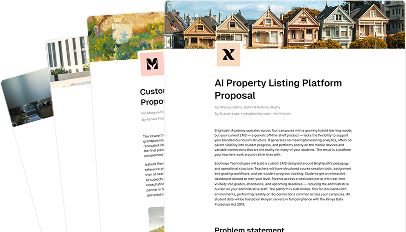
Fix your proposal operations
A lot of losses trace back to inconsistent, slow, or sloppy RFP responses. If your team rewrites the same answers every time, quality and speed both suffer.
Standardize your best answers into a reusable content library so every response starts at 70% complete. Teams that centralize this often manage thousands of answers — the same way enterprises handle a Qvidian to Responsive migration of 5,000+ stored responses. You don't need that scale, but the principle holds: stop writing from scratch.
What a tighter process looks like
- Qualify every RFP against a fixed scorecard before assigning resources.
- Pull vetted answers from a maintained content library.
- Customize the 30% that's deal-specific — outcomes, pricing, team.
- Review with one accountable owner, not a committee.
- Submit early and follow up with a tailored walkthrough.

When you should let the cheap deal walk
Not every loss is a failure. If a prospect only cares about the lowest number, that's a client who'll squeeze margins, scope-creep, and churn. Winning a race to the bottom isn't winning.
The agencies with healthy margins lose plenty of price-driven RFPs on purpose. They focus pipeline on buyers who value outcomes, often built through account-based marketing for enterprise B2B rather than chasing every open bid.
Key takeaways
- You're rarely losing on price — you're losing on perceived value and differentiation.
- Quantify outcomes, not deliverables, in every proposal.
- Qualify hard before responding; not every RFP is worth your time.
- Speed and consistency win deals; standardize your response content.
- Some price-only buyers should be allowed to walk — protect your margins.
Fix positioning and process first. The pricing gap usually disappears once buyers can finally see what they're actually paying for.