You can spend a week writing the perfect proposal — sharp pricing, a tight scope, a story that lands — and still lose the deal in the first three seconds. Not because of what you said, but because of how it looked on the page.
That's the uncomfortable truth about typography. Before a client reads a single word, their brain has already made a snap judgment about whether you're a serious operation or a fly-by-night one. And a huge part of that judgment comes down to one decision most people make on autopilot: the font.
This guide breaks down the best fonts for business proposals in 2026 — which ones to use, which to avoid, how to pair them, and how to stop wasting hours fiddling with type when you should be closing.
Why your font choice matters more than you think
The font you use directly shapes how people perceive your content. The right one improves readability, sets the tone, and gets out of the way so your message lands. The wrong one quietly chips away at your credibility before you've made your case.
This isn't just designer superstition. People unconsciously attribute personality traits to typefaces — a phenomenon designers have studied for decades. A proposal set in a clean, modern sans serif feels like it came from a competent, current business. The same proposal in Comic Sans? You already know. Nobody signs a five-figure contract that looks like a birthday invitation.
Here's the quick mental model:
Readability — Can your client skim it on a phone at 11pm without squinting? If reading your proposal is tiring, they won't finish it, and they definitely won't sign it.
Tone — A law firm and a creative agency should not feel the same on the page. Your font is part of how you signal who you are.
Trust — Consistency reads as competence. Mismatched, dated, or hard-to-read type reads as "this person rushed it."
Get these three right and your font becomes invisible in the best possible way — the reader just absorbs your argument. Get them wrong and the typeface starts shouting over your content.
The three font families you need to know
Almost every typeface you'll consider for a proposal falls into one of three buckets. Understanding the buckets is more useful than memorizing a hundred font names, because once you know the feeling each family creates, picking a specific font becomes easy.
1. Serif fonts — trust, tradition, authority

Common associations: trustworthy, established, reliable, formal
Examples: Times New Roman, Georgia, Garamond, Baskerville, Century Schoolbook
Serif fonts have small "feet" — the little strokes at the ends of letters. They've been the typeface of books, newspapers, universities, law firms, and financial institutions for centuries, so our brains have learned to read them as serious and authoritative.
Use serif fonts when you're in a traditional or high-trust industry — law, finance, consulting, accounting, anything where "we've done this a thousand times" is the message you want to send. Georgia and Baskerville in particular were designed (or refined) to stay crisp on screens, so they hold up well even in PDFs your client reads on a laptop.
One caveat: older serif fonts with very thin "hairline" strokes can shimmer or break up at small sizes on screens. If you're going serif, lean toward the screen-friendly ones above rather than ultra-high-contrast display faces.
2. Sans serif fonts — modern, clean, approachable

Common associations: modern, clean, approachable, efficient
Examples: Arial, Helvetica, Calibri, Inter, Manrope, Roboto, Open Sans
Sans serif fonts ("sans" = without) drop the little feet entirely. The result is clean, geometric, and razor-sharp on screens — which is exactly why they dominate apps, websites, and modern business documents.
If serif says "established institution," sans serif says "sharp, current, easy to work with." That's why tech companies, startups, agencies, and most B2B businesses default to them in 2026. Inter has become so ubiquitous in modern interfaces that designers half-jokingly call it "the Helvetica of the 2020s."
Use sans serif fonts when you want to feel modern and unfussy, or when you know your proposal will mostly be read on a screen (which, let's be honest, is almost always now).
3. Script & handwriting fonts — personality, used in tiny doses

Common associations: elegant, creative, personal
Examples: Brush Script, Pacifico, Great Vibes, Sacramento
These mimic handwriting and add a human, personal touch. The catch: they're hard to read in long stretches and can tank your credibility fast if overused.
Use script fonts only for a single accent — a cover-page flourish, a signature line, maybe a one-word header. Never, ever set body text or pricing tables in a script font. A little goes a very long way.
The fonts to actually avoid in proposals
Quick blocklist. None of these belong in a serious business proposal:
Comic Sans — the eternal punchline. Instantly amateur.
Papyrus — dated, and forever associated with spa flyers and Avatar memes.
Curlz / overly decorative display fonts — illegible and distracting at body size.
Anything ultra-thin or ultra-condensed for body text — pretty in a logo, painful in a 12-page document.
The "Il1 test" is a handy professionalism check: type a capital I, a lowercase l, and the number 1 next to each other. If you can't tell them apart, the font isn't built for clarity — skip it for body text.
Font pairing: the real secret to a polished proposal
Here's what separates a proposal that looks designed from one that looks thrown together: it's rarely a single font. It's a pairing — one font for headings, one for body text — that creates clear hierarchy and visual rhythm.
A few reliable pairing strategies:
Sans + sans (modern & safe): A slightly bolder sans for headings, a neutral sans for body. Example: Manrope headings with Inter body. Clean, contemporary, hard to get wrong.
Serif + sans (classic contrast): A serif for headings to signal authority, a sans for body to keep it readable. Example: Georgia headings with Arial or Open Sans body.
Sans + serif (editorial feel): Flip it — a confident sans for headings, an elegant serif for body. Great for consulting or research-heavy proposals.
Rules of thumb that never fail:
Limit yourself to two fonts, three at the absolute most. More than that and the document starts to feel chaotic.
Create an obvious size contrast between headings and body so the structure is scannable at a glance.
Keep body text 11–12pt for print, up to 14pt for screen. Smaller feels cramped; bigger feels like you're shouting.
Pick fonts with consistent stroke widths for body text — they're easier on the eyes, including for readers with dyslexia. Accessibility isn't a nice-to-have in 2026; it's part of looking professional.
How to choose the right font for your proposal
When you're staring at a font menu, run the decision through two quick filters.
1. What's the nature of your business and the proposal? Finance, legal, and traditional consulting lean serif — authority and heritage do the talking. Tech, creative, agency, and most B2B work lean sans serif — modern and frictionless. Match the typeface to the promise you're making.
2. Who is the client? A buttoned-up enterprise procurement team and a scrappy startup founder respond to very different visual cues. Picture the person opening the PDF and choose what they'd read as credible — not just what you personally like.
Then do the one test that matters: read it on a phone. If it's comfortable on a small screen, you're good. If you find yourself zooming in or your eyes slide off the page, change it before you hit send.
Stop fiddling with fonts — let Wonit handle the typography
Here's the honest reality: most people reading this don't actually want to become typography experts. You want a proposal that looks great and gets signed, without burning an afternoon testing font combinations in Word.
That's exactly what Wonit’s Proposal Generator is built for.
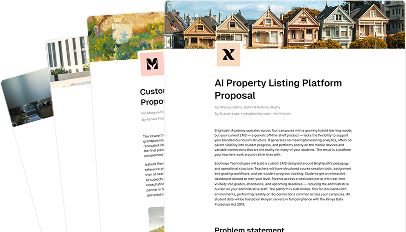
A full library of professional proposal fonts, built right into the editor. Browse beautifully-paired business fonts and apply them with a single click — no downloading, no installing, no hunting through font files. Pick one font for your headings and another for your body, and Wonit handles the hierarchy for you.
Polished headers and clean layouts out of the box. Every proposal comes with sharp, well-structured headers and professionally paired defaults (Manrope and Inter), so it looks designed from the first second — and you can change the look in one click whenever you want.
Hundreds of ready-made business and sales proposal templates. Start from a template with the theme and typography already dialed in, customize it in minutes, and send something that genuinely impresses your client instead of starting from a blank page.
Built-in e-signatures with a full audit trail. Publish your proposal as a live link or export a clean PDF, then collect a legally trackable online signature — so the same document that looks great also closes the deal.
No design experience required. Just pick a template, choose your fonts, and send. The thing you were going to spend three hours formatting becomes a five-minute task.
The bottom line
Typography won't write your proposal for you — but it decides whether anyone takes it seriously. Pick a clean, readable font that matches your industry, pair a heading font with a body font for hierarchy, keep it to two typefaces, and test it on a phone before you send.
Or skip the guesswork entirely. Create your next proposal with Wonit and get professional fonts, ready-made templates, and built-in e-signatures in one place — so your proposals look as good as the work you're pitching.